
Introduction
The difference between raster vs vector images plays a major role in professional graphic design. Designers often face quality loss when they choose the wrong format for logos or printing.
Understanding raster vs vector images helps you create sharp, scalable, and professional-quality designs for both digital and print work.

What Are Raster Images?
Raster images consist of tiny pixels that form a complete picture. Each pixel stores color information, and together they create detailed visuals.
Common raster formats include JPG, PNG, and GIF.
Designers use raster images for photography and detailed artwork because they support smooth color transitions. However, resizing causes pixelation and reduces quality.
What Are Vector Images?
Vector images use mathematical paths instead of pixels. These paths define shapes, lines, and curves.
Common vector formats include AI, SVG, and EPS.
Designers prefer vector images because they can scale infinitely without losing quality. This makes them ideal for logos, branding, and printing.
Raster vs Vector Images Key Difference
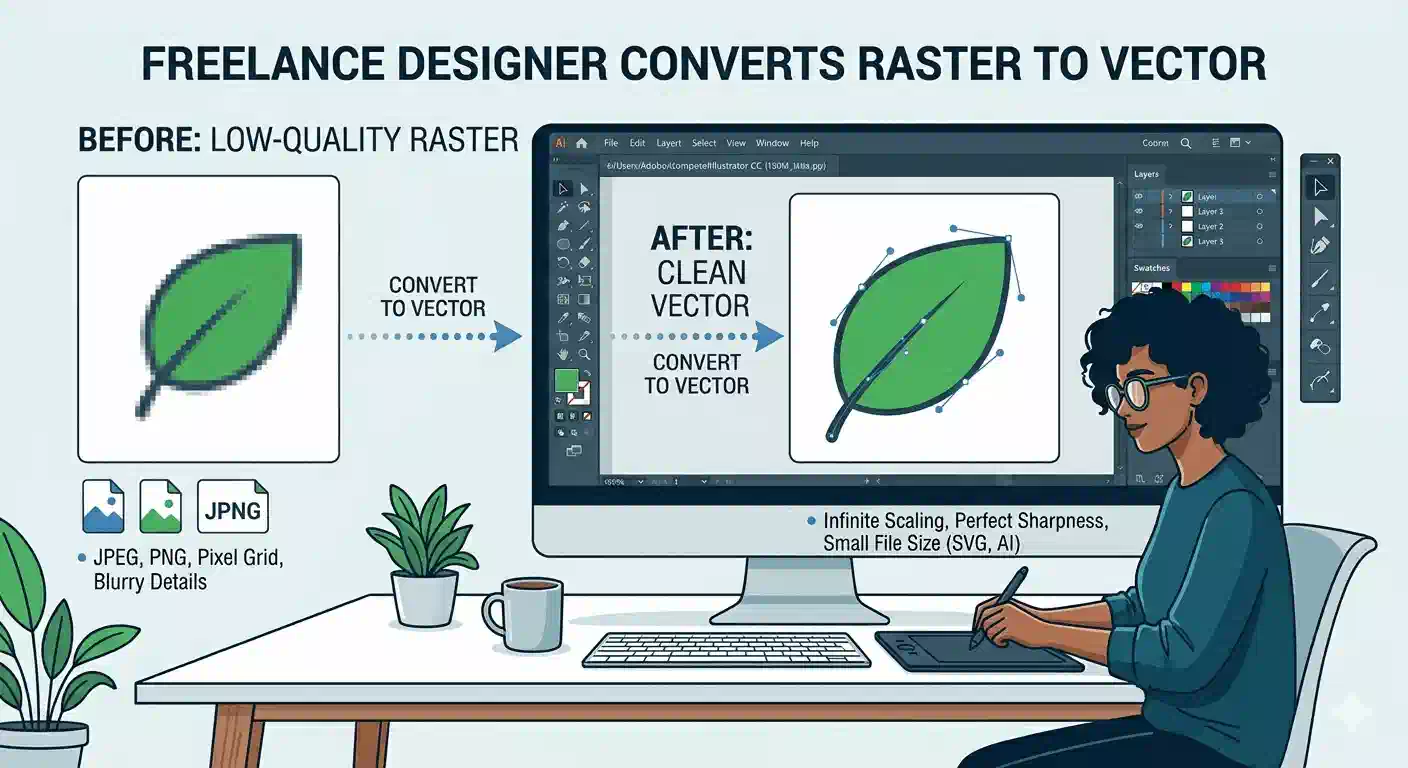
Raster images depend on pixels and lose quality when enlarged. Vector images remain sharp at any size because they rely on mathematical formulas instead of pixels.
Raster works best for photos, while vector works best for scalable graphics like logos.
Why Raster vs Vector Images Matters in Design
Designers improve their work quality when they choose the correct format. Using raster for logos creates blurry results, while vector ensures sharp branding across all sizes.
Logo Design Use Case
Designers always use vector formats for logo creation because logos must stay clear on all platforms, from business cards to billboards.

📌 Example portfolio:
https://vectorscart.com/portfolio-vector-design-samples-work-vectorscart/
Printing Use Case
Printers rely on vector files because raster images lose clarity when printed in large sizes.
Vector formats maintain sharp edges and high-quality output in all print conditions.
Freelancing Use Case
Freelancers increase their value by offering vector tracing services. Clients often provide low-quality images, and designers convert them into clean vector files.
📌 Service page:
https://vectorscart.com/custom-vector-design-services-fast-high-quality-vectorscart/
When Designers Use Raster Images
Designers use raster images for:
- Photography
- Realistic textures
- Digital artwork
- Social media graphics
Raster images deliver rich detail but do not support scaling.
When Designers Use Vector Images
Designers use vector images for:
- Logos
- Icons
- Branding materials
- Print design
Vector graphics ensure scalability and professional output.
Common Mistakes Designers Make
Many designers reduce quality by:
- Using raster for logo design
- Ignoring resolution before printing
- Depending only on auto-trace tools
These mistakes affect professional results and client satisfaction.
Helpful Resources
https://en.wikipedia.org/wiki/Raster_graphics
https://en.wikipedia.org/wiki/Vector_graphics
FAQ
What is raster vs vector images?
Raster uses pixels, while vector uses mathematical paths for scalable graphics.
Which format is better for logos?
Vector format is always better for logos.
Can raster images be converted to vector?
Yes, through manual tracing or vector conversion tools.
Conclusion
The difference between raster vs vector images defines the quality of modern design work. Raster is useful for detailed visuals, while vector ensures scalability and professional branding.
Designers who understand both formats deliver higher-quality and more reliable results.